
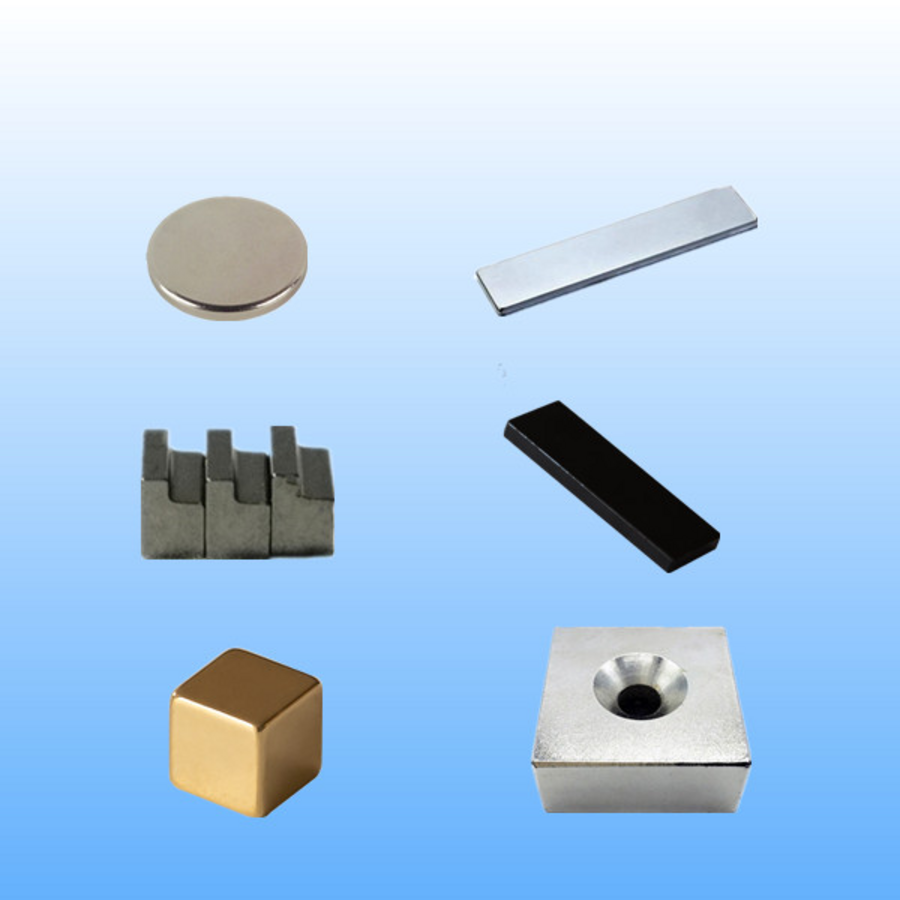
Choosing a permanent magnet material early in a design saves cost and redesign cycles later. This short guide compares the three families we manufacture most — sintered NdFeB, sintered SmCo and hard ferrite — across the four factors that decide most applications.
1. Magnetic strength
If your design is limited by space or weight, sintered NdFeB wins: with (BH)max up to 462 kJ/m³ (58 MGOe), it delivers the highest energy density of any commercial magnet. SmCo follows at roughly 60–70 % of NdFeB's strength, and ferrite provides about one tenth — which is still ample for many sensors, holders and low-cost motors.
2. Operating temperature
Standard N-grade NdFeB is rated to 80 °C, and high-coercivity grades (SH / UH / EH / TH) extend that to 150–240 °C. SmCo remains stable up to 550 °C and shows a very small reversible temperature coefficient — the reason it dominates aerospace and downhole applications. Ferrite works comfortably to around 250 °C but loses coercivity at low temperatures below −40 °C.
3. Corrosion resistance
NdFeB corrodes if unprotected and always needs a coating — NiCuNi is the standard, with epoxy, Zn and multi-layer systems for harsher environments. SmCo and ferrite are intrinsically corrosion-resistant and are normally used uncoated, which removes one failure mode entirely.
4. Cost
Ferrite is by far the most economical and the right default for price-sensitive, high-volume products. NdFeB costs more but often reduces total system cost because a smaller magnet (and a smaller motor) does the same job. SmCo is the most expensive due to cobalt content — specify it when temperature or stability requirements genuinely demand it.
Quick selection table
Maximum field in minimum space → Sintered NdFeB
Above 200 °C or extreme stability → Sintered SmCo
Lowest cost at volume → Ferrite
Complex net shapes, multi-pole → Bonded NdFeB
Not sure? Send us the working temperature, required field and environment — our engineers will recommend a grade within 24 hours.
Our engineers reply within 24 hours.